M. Rajendra
(Former Secretary to the Ministry of Finance, the Treasury and Head of the Public Service 1968 - 1971. Born July 4, 1911- Died March 10,1991)
He strode the Public Service like a colossus with value led dedication and purpose. His passing away was more than the death of a retired Civil Servant. It symbolises the closing period of an important post Independence government institution and ushered in the sunset of a great tradition. Rajendra was all three in one – civil servant, an institution and the symbol of that great tradition.
- Neville Jayaweera, March 24, 1991
In the current global context and today’s reality it is difficult to write an appreciation which will adequately describe a man whose life and interests on earth, were so full and diverse. It can be said of him that there was nothing that he touched which he did not adorn.
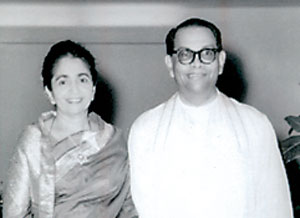 |
| Rajendra and Neela at their daughter’s wedding, 1967 |
He was educated at S. Thomas’ College, Mount Lavinia and University College, Colombo where he received an honours degree in History. He joined the Ceylon Civil Service as a cadet on December 12, 1934, in a career that spanned nearly 43 years.He served in Hambantota, Matara, Kandy, Nuwara Eliya as an Assistant Government Agent and in 1949 became a Government Agent to the Eastern Province and in 1951, the Government Agent of the North Central Province.
As Government Agent in the districts, his main interest was to identify and foster sustainable development activities which would benefit the people and help to alleviate poverty. When he was appointed Land Commissioner in 1954 he saw in the Land Development Ordinance an excellent piece of legislation to reinforce social justice through creating, a self-supporting contented peasantry and community organizations. In this he was fortunate to be supported by four times Prime Minister Dudley Senanayake, his close friend from S. Thomas' College days.
As Permanent Secretary Finance, Secretary to the Treasury and Member of the Monetary Board of the Central Bank he had the opportunity to give full rein to his talents for helping to further the process of an orderly transfer of political power to the people. Whether engaged in policy issues or procedures for effective implementation, his strategy and objectives were quite clear. He had no hesitation in stating his views frankly even to a Minister or Prime Minister if he thought the course of action contemplated may not be in the national interest.
Rajendra had a comprehensive mind, which was able to respond to the complexities and nuances of a situation and acute sensitivity of fundamental values. He wrote and spoke with a great sense of authority and power, yet without causing hurt. He carried himself with a quiet dignity which, inspired awe. He was never belligerent, but by the sheer force of his personality dominated every situation in which he found himself.
He never demanded respect, but through that indefinable something in his personality that is generally referred to as charisma, always commanded it by his very presence. In a service where hierarchy and seniority were important, he was never too busy to find time for imparting his value orientation to his colleagues. Fortunately a few junior colleagues like Neville Jayaweera, Sam Wijesinha, Shelton Wanasinghe, C. Mylvaganam, Bradman Weerakoon, Godfrey Goonetilake and M.D.D. Pieris are still around to articulate his philosophy of administration — Discipline, Integrity, Efficiency and Loyalty to the government in power.
When M.D.D. Pieris, as Assistant Secretary to the Prime Minister’s Office under Bradman Weerakoon, went to see Rajendra, he advised him, “Civil Servants should never ever compromise their intellectual integrity whatever the consequences. Whatever the government in power, after giving them what you think is correct advice, whatever decision they make, you must carry out with total commitment, as long as it does not compromise your values and integrity. An administrator’s role was to advise the political bosses according to the truth, and never give advice merely to please them, however costly it might prove to do otherwise... There was a fundamental difference between an administrator and a manager. Most Civil Servants were excellent administrators. Not all of them were good managers”.
Pieris then goes on to say “Rajendra was an Icon to all of us young Civil Servants”.
Rajendra was more than a first class administrator. He was a deeply compassionate human being. Although he showed an austere exterior, he was actually a deeply humane person to whom one could go with problems, even of a very personal nature. He had stature, moral stature. He had a sufficient sense of inner worth not to have to claim rank or position to enforce his will. He could apologise to his juniors and subordinates, and do so with grace and without loss of respect.
Rajendra’s family were from Vaddukottai, Jaffna. But the parents migrated to Malaysia. Rajendra, his brother Queens Counsel and former Minister of Justice M. Thiruchelvam and sister returned for their education to Colombo. Rajendra married Neela Wignaraja, daughter of Dr. G. Wignaraja and sister of Deshamanya Dr. Ponna Wignaraja and Sathi Wignaraja.
Their three children Malathi, Jayantha and Ajita with their families are now settled in the United States
Click Here for the Original Article



No comments:
Post a Comment