Saturday, June 26, 2021

Arm of treasury, PED benumbe

 8th November  1998 Sunday Times

The reoriented division had to shift from the input control methods of control and command to relationships of partnership. The second stage was routinisation, where all these innovations were to become entrenched to enable the formation of a new culture.
By M Somasundram

Unsettling reports have appeared in the popu lar press about the forthcoming abolition of the Public Enterprises Department (PED) of the General Treasury. Since these reports have not been contradicted it is surmised that they are true. 

The purpose of the article is to indicate why it was necessary to create the PED - partly by continuing the existing Corporations Division of the Treasury - responsibilities PED was expected to wield, conjecture on some of the possible reasons for the suggested abolition and canvas a case for retention. 

The 1970 election victory of the SLFP, in association with its junior partners - the LSSP and CP - was the culmination of the trend towards corporatisation of the state, set in motion in the 1930's. N.M. ImagePerera, the leader of the LSSP was given the important portfolio of Finance in the 1970 government. 
A component in the ideology of a corporate state was that public corporations take over, not only the strategic economic sectors but also the dominant commercial ones in the private sector, in order to allocate - through a rational plan - surpluses for further national development. In a corporate state the Minister dominated the market to enable surpluses to be generated - without exploiting the consumer-public corporations needed to be made to function economically, efficiently and effectively. These 3Es deal with output control. Public departments, on the other hand, were managed by input control. They were reviewed as to whether their expenditures were within the ambit of appropriation, whether they were incurred with integrity, and whether they were within the sum provided. 

The control agencies in the Treasury responsible for public departments were the budget division and the finance division. The budget division allocated the funds and the finance division looked at whether expenditures were incurred within the rules. The personnel who were responsible for undertaking these responsibilities needed administrative skills not managerial ones. Goods governance for public administration was not to make waves or put the hand in the till. Maintenance of the system was important for public administration but performance was not emphasized. 

In this culture of input control, Dr. N.M Perera correctly felt that public corporations should strike out on new paths. New mechanisms of control based on output were required.These output control measures were to be exercised by a new cadre of managers specialised in this field. 

Accordingly, Dr. N.M Perera created the Corporations Division in the Treasury in 1971. Its legislative mandate was given by Finance Act No 38 of 1971. The personnel required to implement this Act which was the good governance agenda for a corporate state - required managerial skills with a strong finance background. 

Accordingly, the first Director of Corporations Division was P.M.W Wijesuriya, a very senior Chartered Accountant. He built an enviable team of professional accountants to help him with the task of building the division. On his promotion as Auditor-General, he was succeeded by his deputy, M.K.S.K. Siriwardhana who was also a very senior Chartered Accountant. 

On his promotion as sen ior Deputy Auditor General he was succeeded by his deputy, - the late M.J. Silva - another senior Chartered Accountant. Dr. N.M. Perera was a demanding and brilliant finance minister. He was extremely happy about the performance of the corporations division in its drive towards establishing an efficient corporate state. So was Felix Dias Bandaranaike who succeeded to the finance portfolio. 

The 1977 election brought the UNP to power. It had a different concept of the state. The state was liberal with the corporations sector playing a diminishing role in commercial activities. The private sector was clearly demarcated as the engine of growth not the corporations sector. 

The market was more important than the minister. If corporations needed to be retained then they should be able to compete with the private sector on a level playing field. The corporations inherited by the UNP were monopolies functioning with administered prices. To make them congruent with UNP policy they had to be re-oriented. 

Such a re-orientation was to be initiated by the finance ministry under the new UNP Minister Mr. Ronnie de Mel. He decided that the stimulus was to be from two sources, firstly from a revamped corporations division and secondly from Parliament whose active support was to be canvassed to achieve this aim. It would have been the easy option to abolish the corporation division, distribute its functions hither and thither. But Ronnie de Mel, being a knowledgeable historian and seasoned Civil Service administrator, before he graduated into politics, realised that such a policy was short-sighted and will only lead to dither. He felt, and correctly, that the challenge was to re-orient the corporations division thus retaining its excellent personnel but yet equipping it for the new tasks. It was a question of elevating the existing corporations division to function at a higher level. 

As a management theorist, Ronnie de Mel knew that there were two stages in such a re-orientation, the first was the charismatic stage where a new vision, a new mission and new systems needed to be developed. In this first stage the newly reoriented division would cultivate trustworthiness among the corporations, which it served, so that they could have satisfaction that they had a friend in the forbidding Treasury. 

The reoriented division had to shift from the input control methods of control and command to relationships of partnership. The second stage was routinisation, where all these innovations were to become entrenched to enable the formation of a new culture. 

The two stages required directors with quite different set of skills. The first stage required leadership skills and the second stage management skills with a mastery of higher level finance and accounting. 

But before implementation, Mr de Mel sought the assistance of C. Balasingham to study issues and make recommendations. Mr. Balasigham was an outstanding civil servant of the 1960's and his period, as DST in the treasury of the 1960's, was legendary. He was now in retirement but was yanked out for this study. There could not have been a better choice. Mr. Balasingham made an extensive study, particularly of the workings of the Indian Bureau of Public Enterprises (BPE) and offered a comprehensive report. One significant component was the addition of Advance Accounts to the portfolio of the future organisation. Advance Accounts are commercial activities of government carried out by government departments. Some of the largest organisations in Sri Lanka, whether in the public or private sectors, were advance accounts one example being the Food Department. They too needed to be made managerial. 

Mr. Balasingham recommended on the structure and processes of the new organisation, which he called the Public Enterprises Division (now department). The PED was to be built round the core of the earlier Corporations Division., but with the addition of Advance Accounts. The Balsingham report was extensively discussed at the Treasury and accepted. 

Mr. de Mel then had to choose the first head of this division. The first stage needed distinctive capabilities in institution building. The selection was the serving director of budget. This director budget was a civil servant and had converted, in 1974, an hoary. division of the treasury called supply and cadre into the budget division with the simultaneous introduction of the planning, programming and budgeting system (PPBS). The PPBS transformed a line budget into a program budget which applied to all ministries and departments at the same time. It was an enormous system change, which if not handled properly, would have led to a collapse of the finance system of Sri Lanka. The transformation was carried out without a hitch. The budget division was restructured on the lines of the US Organisation and Management Bureau (OMB). 

A Select Committee of Parliament was appointed to consider and report on the Standing Orders and the setting up of a new committee of Parliament, as the corporation sector had expanded so much that it was felt that a completely separate body, similar to the PAC should perform these functions for public corporations. 

The recommendations of the Minster of Finance specifically stated that PED will provide the skills to the new committee. Subsequently Parliament amended the Standing Orders to set up a new Committee on Public Enterprises, as recommended by the Cabinet of Ministers and approved by the Select Committee. Consequently Parliamentary review of public corporations was shifted from the PAC (now COPA) to this new Committee of Public Enterprises (COPE). But there was a significant change in COPE list of responsibilities. 

Earlier the PAC was charged only with reviewing accounts that is of past activities as presented by the Auditor General. COPE in addition to this responsibility was to monitor (that is review the present) and check on corporate plans (that is analyse the future). In both these activities COPE was to be assisted by PED, a distinct structural change in governance. By this measure the legislature and the executive were to work in closer collaboration. The PED was able to undertake the activities because it was the focal point for all matters pertaining to public corporations. 

Therefore it knew everything about each individual corporation, its attempt being to know more about it than their managements. In this it was successful as the enthusiastic support given by COPE to its recommendations testifies. If bits and pieces of its responsibility had been distributed to other agencies in the Treasury, the impact of PED initiatives would have been minimal and COPE would have become another COPA for public corporations concentrating only on the past, as revealed by the accounts presented three or four years later. 

Mr. de Mel also arranged a 7 week tour for COPE where it visited the United States, Costa Rica, Britain, France, Yugoslavia and India and the institutions of the World Bank, International Monetary Fund, UNDP and the International Centre for Public Enterprises. 

Following on this study it made its first report called "Parliament and Public Corporations" in 1980. The COPE spelt out its credo, what it expects to do, and how it expects Public corporations to be reviewed. In this report it emphasised that the processing required for the analysis of performance be undertaken by the PED. The COPE said that "it will require it (PED) specialised skills if it is to radiate modernising influences into public corporations". From all accounts the PED has fulfilled these expectation of COPE from 1980 to the present day. 

In addition to the Balasingham and first COPE report, the new director benefited from the recommendation of an international team of experts on how this focal point should be structured and function. The team was headed by Praxy Fernandes, the Secretary, Ministry of Finance, Government of India and former head of BPE and two British academics specialised in public enterprises. 

This report was reviewed extensively by heads of corporations and approved by the Cabinet Secretary G.V.P Samarasinghe as Chairman of the Committee of Secretaries. Once the PED was created an extensive programme of training was undertaken which included the politicians forming the COPE. They were marooned in Hunas Hotel for a week where they benefited from an intense program of management training. 

By end 1983 the first di rector felt that the charismatic stage was over and the routinisation stage has to take over. He voluntarily withdrew from the post but was asked to nominate the successor. He accepted an international assignment in which he was instrumental in setting up similar focal points in Tanzania, Jamaica and Seychelles. 

He scanned the SLAS list but found that there was no one with the required skills to fill the post. He nominated his senior deputy, a senior chartered accountant who has gained post graduate qualifications from the ISS Netherlands on public sector management and a masters from Harvard in management. The nomination was accepted and she has been holding the post from 1984 up to today. 

Under her direction the PED has not only satisfied the COPE and public service expectations but the Institute of Chartered Accountants has nominated the PED for training of its chartered students. The only other agency recognised in the public service for this purpose is the Auditor General's department. 

This testifies to the excellence of staff working in the PED, which staff is now threatened with dispersal. With PED abolition the staff is entitled for retirement with abolition of office terms. At a time when a brain drain is affecting the public service, a policy of sponsoring the draining of brains in hardly a policy of good governance. It should be mentioned that PED staff had undertaken short term international assignments in Seychelles, Tanzania, Nigeria, Botswana and South Africa. 

Public Corporations are now facing challenges both at vertical and horizontal levels. The vertical level globalisation and liberalisation has compelled them to take a fresh look at their vision and mission and develop appropriate structures and systems. At the horizontal level they have to shift from a public department to a corporation to company and to privatization. 

All these changes have to be thought through and choreographed by a focal point on public corporations. Public Corporation numbers are also in the increase. Even today parliament's order page has a proposal to create a corporation called the Aqua- Culture Development Authority. 

Distributing bits and pieces of PED to other agencies is not the answer. If other agencies are dealing with aspects of public corporations the rational approach would be to transfer them to PED, though this is not recommended since there must be some reason for such a practice. 

The PED was created after considerable study, the seminal document being the Balasingham report. It also benefited from the Praxy Fernandes report which was published and extensively discussed. 

It is claimed that the abolition of the PED was based on a management report the composition of which is not known nor its contents. 

Vasudeva Nanayakkara, M.P., a concerned member of COPE, has asked that a copy be tabled in parliament. 

This is not a confidential document and when it is presented the reasoning would become evident. But the proposed manner by which the proposal is to be implemented does not offer inspiring moments. 

The Corporations Division was created to implement Finance Act No 38 of 1971. This is yet in operation. But no agency has been given this load bearing responsibility under the new dispensation. 

Also deficiencies of management principle and management practice are legion. The present proposal to abolish the PED and the manner proposed for distribution of its functions will become a case study of how management change should not be undertaken. Some management familiarity by its authors would not have come amiss. 

However, an institution that has existed since 1970, developed so carefully by excellent finance ministers like Dr N.M Perera and Ronnie de Mel and which has performed its tasks without criticism needs better justification for abolition than a secretive report. It is the tragedy in Sri Lanka that some of its best institutions have been abolished because political leadership has been misled by bureaucratic scheming. 

An excellent example is the abolition of the Ceylon Civil Service a decision which everyone now bemoans including those who abolished it. 

A more recent example is that of SLIDA, details being found in a case study called "Bureau pathology at the SLIDA" published by Konark in the book "The Third Wave: Governance and public Administration in Sri Lanka", 

The destructive hurricane from the SLIDA has now come to the Finance Ministry. It takes giants to build but only pygmies to demolish. It is best if the decision to abolish the PED were kept in abeyance pending a thorough review. 

In this review the views of COPE would be important. Similar to C. Balasingam recommending on the PED an outstanding public servant should review all aspects of the proposed abolition. The name of Gaya Kumaranatunge, a former DST, a Director of the ADB and currently in the private sector springs readily to mind. 

Click Here for the original Article

Arthur Ratnavale: An artistic Civil Servant

 November 18 2020, Daily News

Unexpectedly passing away from a heart attack at 54 in the midst of his term as Sri Lanka’s Ambassador to what was then West Germany, Arthur Ratnavale’s death in December 1974 cut short an impactful and illustrious life. Those close to him remember his thoughtful, somewhat philosophical yet precise, confident and commanding personality. Similar contrasts surface in his old Ceylon Civil Service administrative exactness entwining with an artistic passion influenced by the likes of his famous Trinity College art teacher David Paynter, and inspired by his admiration for the French impressionists. On his hundredth birth anniversary which falls on November3, 2020, this article wishes to serve both as an appreciation and a journey through his interesting life.

The sixth of eight children, many of whom went on to distinguish themselves in the medical field, Arthur Ratnavale’s career took a different route.  Educated at Trinity College Kandy in the era of Headmaster’s such as Rev John Cambell and the Rev John Stopford who later went on to become Bishop of London; the school’s strong Christian influences manifested in many of his paintings. His links with Trinity were strong and after graduating with History Honours he came back to teach briefly. His former pupils whom include former Ministers Lakshman Kadirgamar who he taught English and History, and Prof Tissa Vitharana to whom he was a House Master at Napier House, have recalled this involvement with respect and fondness. Indeed, sometimes reflecting on his life, including many of the senior positions held he would often say that he enjoyed his job as a teacher at Trinity more than anything else he had done. Fittingly, decades later he also served as a Governor of the School.

Teaching was still a brief interlude. After little over a year he sat for and passed the highly competitive Ceylon Civil Service exam in an era when only around three persons were permitted career entry annually. The diverse exposure the Civil Service provided would naturally have been a source of strength to the very senior positions held later in his career. This diversity included exposure in different parts of the country in the roles of: Assistant Government Agent (AGA) Matale, AGA Kurunegala and later Government Agent Ratnapura. There was exposure in different departments and Ministries such as: Customs, Trade and Commerce, Information and Broadcasting, Tourism and Census and Statistics. There was also exposure overseas including a three month training programme in Australia, visits to Peeking in the capacity of Rubber Commissioner for rubber rice talks and visits to Prague, Geneva and Rome on Government business.

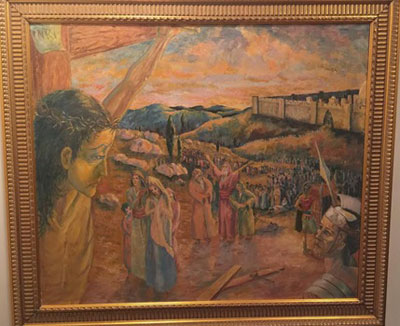
Entwining with all this was his love of painting and art and before referring to the more high profile appointments he later held, the article seeks to do justice to this pastime. Contextually the observation at the outset that artistic passion represented a contrast to his administrative exactness requires qualification as even here he took meticulous care over his work. The contrast with exactness was in his unfettered and adventurous use of colour; possibly the influence of his Trinity links with David Paynter but even more likely his favourite artist Paul Gauguin.

Arthur Ratnavale’s painting of the crucifixion


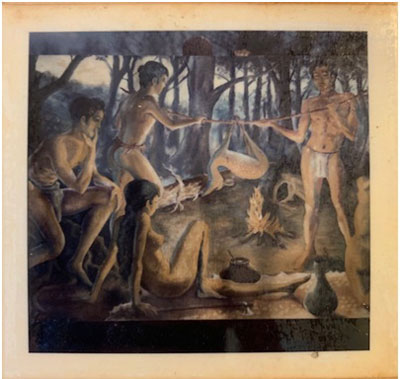
Two strands were evident in his art. One consists of Sri Lankan rural and jungle scenes which he would have enjoyed when on civil service circuits. These include paintings of village life, veddas and some integrating seascapes. The other connects with his strong Christian beliefs and upbringing. In the case of the former what comes to mind are paintings of women bathing at a well, fishermen overlooking the sea and veddas carrying a deer after a hunt. In the case of the latter I am reminded of his painting of the Cologne Cathedral interior, the expulsion of Adam and Eve from the Garden of Eden and of course the crucifixion. A painting where the two strands coincidentally combine is a view of the Hanthana hills seen through the pillars of the Trinity College Chapel.

Arthur Ratnavale’s representation of Veddas after a hunt


With the advent of Sirimavo Banadaranaike’s Government in 1970 Arthur Ratnavale was appointed Permanent Secretary Defence and External Affairs when both portfolios were combined under Prime Ministerial purview.  As this is a personalized reminiscence and nearly fifty years have passed, I thought to convey an interesting anecdote he shared with those close to him that convey something of him and his times.
Exemplified by the deposing of Presidents Kwame Nkrumah of Ghana in 1966 and Milton Obote of Uganda in 1971, coup d’ etat during these times were not  infrequent. Mrs. Bandaranaike having experienced the 1962 failed coup was not immune to such concerns and it was decided to request US intelligence to assist investigations on anything that may be developing. But Sri Lanka was adept at walking the tightrope to balance the powers, and with perspectives that foreign intelligence services were also allegedly involved in conspiracies, the same was later requested of the Russians. He told me that the US official who visited was a serious almost academic individual but ironically the Russian had more of the trappings of what Hollywood would ascribe to an intelligence agent. The Russian operative had been very amused when he told him that he seemed to have the qualities of 007.

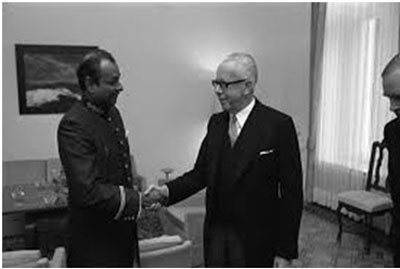
Arthur Ratnavale with former German President Heinemann


Arthur Ratnavale’s last appointment as Sri Lanka’s Ambassador to the Federal Republic of Germany, whilst being a pleasant posting was not without its challenges. Relations between the countries were a little strained on account of Sri Lanka’s early recognition of East Germany when put in the context of the wider goal of German unification. He was therefore happy to see an improvement in relations after the state visit of Mrs. Bandaranaike to Germany in September 1974. He was also pleased to enable the German Charter Airline Condor to obtain landing rights in Colombo during his tenure which saw West Germany overtaking France to then become the largest tourism source market.

Despite an involved career Arthur Ratnavale was a committed family man and his devoted wife Poowathie was a boundless reservoir of support both with his career and with the family. His death left a huge void in his immediate family who missed his strong guidance, wise perspectives and uplifting and sometimes mischievous sense of humour.  Being a young family member who sometimes found his passion for art galleries and museums a little bit of an ordeal, I thought differently of his love of the great outdoors and have fond memories of river baths in the Deduru Oya, boating on Germany’s Maria Lake and a family winter holiday in the Bavarian Alps. He sought to inculcate a strong educational outlook and wide interests in his children. While promoting achievement he also encouraged us to be thoughtful and to be discerningly receptive to ideas. As such in remembering him on this anniversary, it is apt in conclusion to recall a small verse that struck a chord with him to the extent that he made me memorize it

Click Here for the Original Article

His sheer personality dominated any situation

 M. Rajendra

(Former Secretary to the Ministry of Finance, the Treasury and Head of the Public Service 1968 - 1971. Born July 4, 1911- Died March 10,1991)

He strode the Public Service like a colossus with value led dedication and purpose. His passing away was more than the death of a retired Civil Servant. It symbolises the closing period of an important post Independence government institution and ushered in the sunset of a great tradition. Rajendra was all three in one – civil servant, an institution and the symbol of that great tradition.
- Neville Jayaweera, March 24, 1991

In the current global context and today’s reality it is difficult to write an appreciation which will adequately describe a man whose life and interests on earth, were so full and diverse. It can be said of him that there was nothing that he touched which he did not adorn.

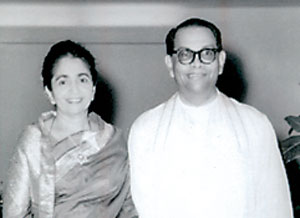
Rajendra and Neela at their daughter’s wedding, 1967

He was educated at S. Thomas’ College, Mount Lavinia and University College, Colombo where he received an honours degree in History. He joined the Ceylon Civil Service as a cadet on December 12, 1934, in a career that spanned nearly 43 years.He served in Hambantota, Matara, Kandy, Nuwara Eliya as an Assistant Government Agent and in 1949 became a Government Agent to the Eastern Province and in 1951, the Government Agent of the North Central Province.

As Government Agent in the districts, his main interest was to identify and foster sustainable development activities which would benefit the people and help to alleviate poverty. When he was appointed Land Commissioner in 1954 he saw in the Land Development Ordinance an excellent piece of legislation to reinforce social justice through creating, a self-supporting contented peasantry and community organizations. In this he was fortunate to be supported by four times Prime Minister Dudley Senanayake, his close friend from S. Thomas' College days.

As Permanent Secretary Finance, Secretary to the Treasury and Member of the Monetary Board of the Central Bank he had the opportunity to give full rein to his talents for helping to further the process of an orderly transfer of political power to the people. Whether engaged in policy issues or procedures for effective implementation, his strategy and objectives were quite clear. He had no hesitation in stating his views frankly even to a Minister or Prime Minister if he thought the course of action contemplated may not be in the national interest.

Rajendra had a comprehensive mind, which was able to respond to the complexities and nuances of a situation and acute sensitivity of fundamental values. He wrote and spoke with a great sense of authority and power, yet without causing hurt. He carried himself with a quiet dignity which, inspired awe. He was never belligerent, but by the sheer force of his personality dominated every situation in which he found himself.

He never demanded respect, but through that indefinable something in his personality that is generally referred to as charisma, always commanded it by his very presence. In a service where hierarchy and seniority were important, he was never too busy to find time for imparting his value orientation to his colleagues. Fortunately a few junior colleagues like Neville Jayaweera, Sam Wijesinha, Shelton Wanasinghe, C. Mylvaganam, Bradman Weerakoon, Godfrey Goonetilake and M.D.D. Pieris are still around to articulate his philosophy of administration — Discipline, Integrity, Efficiency and Loyalty to the government in power.

When M.D.D. Pieris, as Assistant Secretary to the Prime Minister’s Office under Bradman Weerakoon, went to see Rajendra, he advised him, “Civil Servants should never ever compromise their intellectual integrity whatever the consequences. Whatever the government in power, after giving them what you think is correct advice, whatever decision they make, you must carry out with total commitment, as long as it does not compromise your values and integrity. An administrator’s role was to advise the political bosses according to the truth, and never give advice merely to please them, however costly it might prove to do otherwise... There was a fundamental difference between an administrator and a manager. Most Civil Servants were excellent administrators. Not all of them were good managers”.
Pieris then goes on to say “Rajendra was an Icon to all of us young Civil Servants”.

Rajendra was more than a first class administrator. He was a deeply compassionate human being. Although he showed an austere exterior, he was actually a deeply humane person to whom one could go with problems, even of a very personal nature. He had stature, moral stature. He had a sufficient sense of inner worth not to have to claim rank or position to enforce his will. He could apologise to his juniors and subordinates, and do so with grace and without loss of respect.

Rajendra’s family were from Vaddukottai, Jaffna. But the parents migrated to Malaysia. Rajendra, his brother Queens Counsel and former Minister of Justice M. Thiruchelvam and sister returned for their education to Colombo. Rajendra married Neela Wignaraja, daughter of Dr. G. Wignaraja and sister of Deshamanya Dr. Ponna Wignaraja and Sathi Wignaraja.

Their three children Malathi, Jayantha and Ajita with their families are now settled in the United States

Click Here for the Original Article


A politician who wanted to live a free man in a free society

Sunday October 24, 2010 : Sunday Times

Tribute to C.P. De Silva
By Dr. Karunasena Kodituwaku (The writer is Secretary of the Senanayake Foundation)

C.P. De Silva, the Minister of Lands, Land Development, Irrigation and Power from 1956 to 1970 except for a few months in 1959 and 1960, devoted his life to the North Central Province. Thirty eight years after his demise he is still referred to as “Minneriya Deviyo” (The Angel of Minneriya).

Charles Pervical De Silva, fondly known as CP to his friends and colleagues, passed away after a brief illness on October 9, 1972. He was one of those rare politicians who represented the large and difficult Polonnaruwa District, at that time the Polonnaruwa electorate, for 13 unbroken years from 1952 and subsequently the Minneriya electorate from 1965 for the next five years. He was the only hope to the poor farmers of the entire Polonnaruwa District for 18 long years, until he too was caught in the UNP debacle in 1970 and lost by 1000 votes.

The election result released early that night, not only shocked the people of the Polonnaruwa District but the whole country. All knew if CP had lost, the UNP Government would lose too. It was only a few months before that the Prime Minister Dudley Senanayake laid the foundation stone for the Polgolla Diversion commencing the biggest single multi purpose project ever – the Mahaweli irrigation project, for which CP had dedicated his entire Civil Service from 1935 to 1952 and his political career from 1952 to 1970.

He was born on April 12, 1912 at Randombe, Balapitiya. His father C.R. De Silva was a well known Attorney-at-Law practising at the Balapitiya Bar. He began schooling at Dharmasoka College, Ambalangoda and soon moved to S. Thomas’ College Mount Lavinia. He was a brilliant student at S. Thomas’ and became the Head Prefect, winning the prestigious Gregory Scholarship and the Miller Award for brilliance in Maths and Science. He then won the ‘Exhibition Scholarship’ to enter the University and graduated with B.Sc Special Maths Honours (First Class).

His professor at the University was Mr. C. Sunethralingam. His parents, who by then were educating the other academically promising members of the family who later became the well known child specialist Dr Stella De Silva, research scientist, Dr L.B. De Silva, a fine civil lawyer A.H. De Silva (MP for Polonnaruwa) and that fine Ceylon boxer Merril De Silva (MP for Minneriya), had no hesitation in sending CP to England to pass out as a civil servant, the most prestigious position to be in under the British administration.

In 1935 CP returned to Ceylon and entered the civil service, as one of the youngest civil servants to ever pass out in the history of civil service in Ceylon. He was promptly sent to Jaffna and then to Puttalam as a Cadet. He then served as an AGA for seven long years in the Districts of Anuradhapura and Polonnaruwa.

As a young and enthusiastic Civil Servant, CP chose to live in the small human settlements surrounded by thick jungle under very difficult living conditions. CP lived alone in the Rest House overlooking the Giritale tank and travelled in a canvas top Willys Jeep once a week all the way to Matale via Elahera to buy milk, eggs, fish and meat to fill his kerosene fridge and other provisions to last the week. Prior to being transferred as AGA Anuradhapura, C.P. De Silva served as an Assistant Secretary of the Ministry of Agriculture under Prime Minister D.S. Senanayake. In 1946, he served as the Assistant Land Commissioner. In 1949, he was elevated to the position of Director, Land Development under Dudley Senanayake who was the Minister of Agriculture. Thus he served the poor farmers under the direction of both D.S. and Dudley Senanayake and is known to have personally overseen the farmer settlements in the entire Rajarata and in particular in the Minneriya colonization scheme.

The Minneriya Colonization scheme was in crisis as it was becoming increasingly difficult to persuade the colonists to stay on. D.S. Senanayake called for his young Assistant Secretary and had given him the task of proceeding to the NCP as Assistant Government Agent to resurrect the dying scheme. CP never forgot the support D.S and C.L. Wickremasinghe, the then Land Commissioner gave him in reviving the Minneriya Colonisation scheme. It is said that his Minister and the Land Commissioner used to accommodate CP for hours in the Ministry in Colombo discussing the Minneriya scheme and the several issues faced by the farmers.

It is also said that at every such meeting, D.S. and C.P. finished the Gold Flake cigarette case pulled out by DS and the tin of Gold Flake brought by CP before retiring for lunch. CP was so closely associated with his Minister and the Land Commissioner that the GA Mr. Richard Aluvihare (later Sir Richard) was quite intrigued with the knowledge CP had of issues connected with land and land settlements and Government thinking on them. So much that the G.A. knew all CP’s requests on behalf of the farmers were met by the Government led by D.S. and Minister Dudley Senanayake. It was no surprise when the proud D.S. Senanayake paid a glowing tribute to the AGA, NCP in the then State Council when the Minneriya Colonisation scheme was revived and became a great success.

Very soon CP was made the Additional Land Commissioner in charge of land development. That was in 1946. The Soulbury Commission also arrived in Ceylon and among the many places visited by the Commission was Minneriya. In fact Lord Soulbury attended a Minneriya Cooperative Society AGM. He was so impressed by the way the meeting was conducted, that he had said, “if in the backwoods of Ceylon the people could conduct a meeting of this nature in such a democratic manner, who could say the people are not fit for self Government.”

On February 4, 1950, he resigned his office and retired to his farm in Puttalam much to the annoyance of his father. One evening, while he was watching paddy being stacked in his farm, CP had a visitor, the late S.W.R. D. Bandaranaike. S.W.R.D’s mission was to persuade CP to enter politics. He succeeded in persuading CP not only to contest from Polonnaruwa but also give leadership to his community in Balapitiya. CP was one amongst a few in the SLFP that managed to win in the 1952 general election.

When C.P. De Silva, as the Minister of Lands, Irrigation and Power presented the Bill in Parliament, in 1970, to establish the Mahaweli Development Board, he stated, “during that seven year period I lived and worked in the Rajarata, I saw while standing helplessly on the Manampitiya bridge just 6 miles away from Polonnaruwa, how the poor suffered when the Mahaweli overflowed its banks during the monsoons and suffer again without water to irrigate, drink or bathe during the Yala seasons. I dreamt for hours how to plan the diversion of the Mahaweli waters coming down the awesome Mahaweli river from the wet zone hills to the dry zone.”

It was this dream that resulted in the planning of the great Mahaweli Scheme by C.P. De Silva to be completed in 30 years in 3 phases commencing 1970. The Mahaweli Diversion scheme was readily supported by UN funding agencies and the UNP government led by Dudley Senanayake who had empathy towards agriculture. But CP was quick to caution the Government that, “the total estimated expenditure on the Mahaweli scheme at the time 1969/70 was three times the national income of 1968 and therefore all the agencies dealing with this gigantic project must be extremely careful about the expenditure associated with the project.” It was unfortunate that after CP lost in 1970, not much progress was made by the government led by Sirimavo Bandaranaike from 1970 to 1977 until J.R. Jayawardane commissioned his young UNP Minister Gamini Dissanayake to accelerate the Mahaweli diversion scheme, which he did with great efficiency.

Out of the 18 years in parliament, late C.P. De Silva was a Minister and Leader of the House for 14 continuous years, except for a couple of months each when he was removed from the Cabinet by W. Dahanayake and when he resigned from the cabinet of Mrs. Bandaranaike. It is also significant that CP held the same portfolio in both the SLFP and UNP governments and retained the post of Leader of the House in all three governments while being a Minister.

Interestingly, on the 25th of August 1959, CP drank the glass of milk meant for S.W.R.D. Bandaranaike at cabinet and collapsed seriously ill. No inquiry was held into this incident. Exactly one month later, the Prime Minister was shot. The PM died on the 26th September 1959. Since CP was undergoing treatment in London, he could not take office as the Prime Minister. But a month later, he returned to lead the SLFP in the 1960 March elections though not fully recovered. UNP got 50 seats and the SLFP 46 seats. The entire opposition backed the SLFP led by CP to form the Government without going for another election at a difficult time, if the UNP did not have a working majority. When the UNP lost the Throne Speech as predicted, the Governor General decided to hold another election in July 1960. At that stage, CP took the unprecedented step for a politician to hand over the leadership of the SLFP to a reluctant widow Sirimavo Bandaranaike. SLFP romped home as winners but Mrs Bandaranaike refused to contest a seat. She was appointed to the Senate. Again, CP was called upon to lead the SLFP in Parliament and was the automatic choice as the Leader of the House. In this context, the observation made by Attorney-at-Law S.L.

Gunasekera, a forthright speaker, at a seminar to commemorate the 31st death anniversary of LSSP leader Dr. N.M. Perera in August 2010, is worth being quoted from the Sunday Leader of August 22, 2010. He spoke on the topic ‘Constitutional requirements for a united Sri Lanka’ and he is quoted to have told the audience, “the reason why Mrs. Bandaranaike became the world’s first woman Prime Minister was because the rightful leadership of the SLFP which at the time should have been given to C.P. De Silva, was denied to him, simply because he was from the Salagama caste.” In fact, the political history of our country would have been different if CP became the Prime Minister in a SLFP government on one of two occasions – after the death of S.W.R.D. Bandaranaike or if he accepted the offer of Dudley Senanayake.

CP shunned cheap popularity and was hardly seen photographed with other Ministers at important and not so important events. Instead, he concentrated more on his pet subject, the Mahaweli project, and restoration of large and minor irrigation tanks in the Anuradhapura, Ampara, Galoya, Moneragala, Wanni and Baticoloa Districts.

Not only did he develop lands and irrigation systems but he is credited with the establishment of the Royal Central College, Polonnaruwa (modelled on the lines of Royal College, Colombo in infrastructure) and the Medirigiriya Central College – both schools with hostel facilities for male and female students and staff quarters, large playgrounds, labs etc. It was C.P. De Silva who developed Mahanama College, Colombo by acquiring land for the school from the Walukaramaya temple close by.

The break point with the SLFP emerged when Mrs. Bandaranaike and the old left with other agendas, began tinkering with the freedom of the Press to survive mounting deficiencies in governance. C.P. De Silva worked according to his conscience. He fought hard against the Lake House Press take over Bill and when the government decided to present it to Parliament against his wishes; he decided to cross over to the opposition. It was a very difficult decision he had to take and it is said he had sleepless nights pondering over what to do. Finally, C.P. De. Silva left not only his powerful Ministries and perks of office but also the Deputy leadership of the SLFP of which he was also a founder member. Eventually CP joined the UNP.

CP’s colleagues in Parliament never thought he would quit the SLFP, although he spoke about the freedom of the press.

On that fateful day of December 3, 1964, history was created. CP crossed the floor of the House in dramatic fashion and made an emotional speech on behalf of a free and unfettered Press (there was no television then). He said famously, “I am foregoing all this today in order to live a free man in a free society.”

Click here for the Original Article 

Thursday, June 24, 2021

Myth of an independent public service

 Sunday Times: Sunday, August 05, 2012

By Tissa Devendra (A retired civil servant) 

I write this article, not as a scholar but as one who has spent his working life in government ‘service’ and hopes that his insights may be thought provoking. My firm conviction is that there never was, and never can there ever be, an independent public service in Sri Lanka. This panacea of ‘independence’ is often touted by well-meaning “liberals”, far removed from the sticky mud of our political scene, as the cure to all our country’s administrative ills. My contrary views are based on my over 30-odd years of government service. I deliberately avoid the euphemism ‘public service’ as it is quite clear that my colleagues and I served the government and not the public – who, at best, could be described as collateral beneficiaries of our actions.

Colonial Period
Let me begin with a brief overview of the administrative scene in late Colonial Ceylon.
Within the broad parameters of British Colonial policy, the country was run by a cadre of executives, both English and Ceylonese, of the Ceylon Civil Service [CCS] selected by competitive exam. The few Ceylonese in this service were drawn from elite famiies who had more in common with English values and ‘mores’ (in language, religion and behaviour) than with their more humble countrymen. Below them was a cadre of clerical officers, also selected by exam, who kept the wheels of administration turning. The situation in the provinces was rather different. The CCS Government Agent governed Divisions headed by senior local officials from leading families who, in turn, administered villages run by Headmen, often hereditary. All administration and records were in English – as the Colony was run for its English rulers. The concept of running the country for its people just did not exist. There was a rudimentary legislature, elected on a very limited franchise, which had no authority at all over government administration. Here, maybe, we see the seed of the ‘independent public service’ – a cadre of government servants who were not subject to direction by, and thus ‘independent’ of, politicians of the local legislature. They were, however, not at all ‘independent’ of their Colonial masters and their duty was to carry out their directives.

Self Government
The Donoughmore Constitution of 1931 introduced universal suffrage and an elected State Council with wide ranging powers of self government. Authority over all government servants was yet vested in the Colonial Governor who acted on the advice of the new institution of the Public Service Commission (PSC) of three “eminent persons” chaired by the Chief Secretary, the Head of the CCS. The Executive Committee system of the State Council now provided the first loophole of authority for legislators to influence government servants. Each elected Member was assigned to a particular ExCo entrusted with a specific portfolio of subjects. Members soon realized that this meant the creation of posts in the Departments fell within their jurisdiction. While the PSC ensured that the proper criteria were followed in recruitment (e.g. objective examinations) it was the ExCo Members who interviewed the ‘short list’. This provided an opportunity for discreet horse trading and the selection of candidates representing specific interest groups or ‘block votes’.

Political Independence
Soon after the British granted Ceylon political Independence in 1948 the Soulbury Constitution was adopted and a new Parliament, in the Westminster model, was elected. At this stage it is important to record some important features in Ceylon’s body politic which have a bearing on my ‘thesis’. Our population was about one third of today’s. National politicians and the higher echelons of government service were almost a “gentleman’s club” of men educated in English at the bigger schools in Colombo and district capitals. The new Public Service Commission of ‘eminent’ men became a sinecure and an ‘ambalama’ for senior politicians (e.g. E.A. Nugawela, Hector Kobbekaduwa). In this ‘way of life’ the exercise of political influence, however, was never obvious – just a whisper in the year to a fellow member of that “gentleman’s club”. Thus, there was no difficulty in shoe-horning a Minister’s son into the CCS or, some years later, increasing the number of vacancies originally advertised in order to rope in another Minister’s nephew.

Before long Ministers and constituency elected MPs grew dissatisfied with their inability to control/direct government servants who yet harboured the illusion of an ‘independence’ protected by the PSC. Gradually, though never openly acknowledged, a ‘modus vivendi’ developed with Departmental Heads falling in line with Ministers’ “requests” and Government Agents in districts paying heed to the concerns expressed by local MPs of the governing political party. This cosy state of affairs carried on for the next eight years under the paternalistic and conservative UNP government.

1956 and after
All this changed drastically with the watershed election of 1956. The man in the street and village now felt that old ruling class (elitist politicians and their unresponsive bureaucrats) had to be swept out. More Sinhala-speaking sons of the soil, many beneficiaries of free education, now manned the Cabinet and wielded the levers of power. They eschewed the cautious advice of old school bureaucrats and, instead, gave them orders to implement policies and activities deemed to be people friendly – as this claimed to be the People’s Government.

Political directives to government servants gradually became the norm. No longer was this ‘interference’ (as claimed by senior officials) restricted to Ministries and Departments in Colombo. Before long they percolated down to the districts which handled grass root services and directly impacted on rural peasantry. This long suppressed populace began demanding that the MP whom they elected respond to their local needs. The MP, in turn, began to express these requests as ‘orders’ to local officials – whether Village Headman, Police Officer, Divisional Revenue Officer, Govt. Agent. Irrigation Engineer, School Principal, etc. If and when the MP’s order was not carried out, the officer in question was deemed uncooperative and “not one of US”. It did not take long for the MP to move at a higher level and get the offending officer moved out. As time went on, villages, Police Stations, Revenue Divisions and districts all came to be staffed by “our” officers, appointed after obtaining the MP’s approval and, therefore, subservient to his directives. Officials soon realised that there was no longer any point appealing to the ‘independent’ PSC packed with government appointees. To all practical purposes the ‘independence’ of government service was now in suspended animation.

The Two Republican Constitutions and Political Control
The mythical ‘independence of the Public Service’ was finally laid to rest by� the Republican Constitution of 1972 which abolished the PSC and vested all its powers (appointment, transfer, punishment, dismissal) in the Cabinet of Ministers. This was an honest acceptance of the ‘status quo’. The Second Republican Constitution of 1978 made the cosmetic re-introduction of a Public Service Commission which, however, had no jurisdiction over the highest posts in government service. We yet labour under this Constitution though it has been tampered with in significant ways.

‘Independence’ of Elections
Soon after Independence the Commissioner of Elections was the Head of a Department under the Minister of Home Affairs and subject to his directives. After 1956 this Department was placed under the authority of Parliament and, as such, beyond the reach of any Minister. Under a Commissioner of legendary integrity, general and local elections came to be held with honest efficiency. He ensured that all elected legislators vacated their offices and surrendered all official entitlements (bungalows, cars, chauffeurs, etc) to the Heads of their Departments. This led to the proud claim of government servants of that period that it was they who ran the country from the dissolution of the legislature till a new administration was elected. And this was true from the GA, who was the Returning Officer, to the ordinary clerks who manned the polling booths and the policemen who provided security. They enjoyed an ‘Indian summer’ of freedom from political pressures.

This state of affairs did not last too long. It had rested on the foundation of ‘gentlemen legislators’ who played by the rules. With the new powers granted to them over government servants, MPs were only too ready to bend the rules. While the Elections Commissioner himself was beyond their power, every other government servant was under their thumb. In short, this meant that ruling party MPs and Ministers, to this day, no longer surrender their perks of office but blatantly use every resource at their command for election work. They know full well that no Head of Department will have the guts to assert his authority and insist on the return of government property thus misused. The Commissioner General of Elections, the MPs know, is but a toothless tiger issuing pious warnings and circulars which have no effect. Government servants turn a blind eye to all these transgressions as they know how they were appointed and who can kick them out. Technically speaking our elections were largely ‘free and fair’, but subservience of government officers to political authority has weakened beyond repair the once strong framework of the electoral process.

District Political Authorities
In the mid-1970s the government in power made a bold attempt to seize direct political control over District Administration by appointing a local MP as� ‘District Political Authority’ (DPA) for each district. He was to have the same ‘status’ as the GA and wield administrative authority over all “development oriented” government servants in the district. This was an ill thought of scheme. It was the GA who yet exercised all statutory authority while the DPA had only political muscle. Tension was inevitable between administrative limitations and political compulsions. District Administration thus limped along with these dual centres of authority, and government servants found themselves in the middle of a tug-of-war. This confusion undermined the efficient running of districts. So much so that this scheme disappeared without a whimper when the Government, that rashly implemented it, was unseated at the General Election of 1977. However, the GA was never again to have the authority and stature he wielded earlier. Henceforth all District Coordinating Committee meetings (as well as other district level bodies) were headed by the senior-most government party MP – no longer by the GA.

Im-Permanent Secretaries and� Diplomats
That interesting appointment, originally designated ‘Permanent Secretary’ under the Soulbury Constitution, has had a chequered history. These officers were appointed by the Governor General (later President) over and above the jurisdiction of the PSC. Their function was to interpret and ensure the implementation of Ministry policy by the Departments of the Ministry as its administrative Head. The first cadre was drawn from the senior-most officers of the CCS. As time went on, Ministers grew increasingly impatient with, what they felt was, the excessively regulation-oriented approach of these officials. Their first move was to do away with the criterion of seniority and appoint ‘bright young sparks’ from cadres other than the CCS, as well.

It became increasingly clear that what Ministers required were Secretaries who shared their political orientation and were ready, if and when necessary, to bend rules to achieve these ends. Later on, as at present, the search for ‘cooperative’ talent has been widened and these Secretaries are no longer drawn from government service but from an amazing variety of backgrounds – e.g business, banks, universities and political families. Failing to fall in line with his Minister meant the abrupt removal of the Secretary, quite often without the courtesy of notice – hence the excision of the original description of ‘Permanent’ from their designation. Any illusion these officers may have harboured of their administrative objectivity was rudely dispelled when one of our Presidents brusquely ordered them all to attend the annual sessions of his political party. No longer was there any question of their being other than political henchmen.

Our Foreign Service, with its postings to glamorous cities, was a much sought after plum in government service. Recruitment to its cadre was by a stiff examination. However, the post of Ambassador was never the preserve of senior career officers. All governments retained the right to appoint ‘outsiders’. Originally these were a small number of ‘eminent’ retired politicians, university dons and business leaders. As time went on, the demand for these plums from family members and political ‘godfathers’ could not be resisted so that today, career diplomats seem to be outnumbered by these amateurs. It should also be noted that there has long been a practice for spouses, offspring and siblings of politicians also to be accommodated in low profile non-executive positions (including typists, peons, cooks and chauffeurs) in our embassies. It can no longer be claimed that our Foreign Service is independent of political meddling.

Political Trade Unions
Soon after the watershed General Election of 1956, trade unions in the non-executive government sector were legalized. The first such TUs restricted their activities to matters concerning their employment, and steered clear of national political parties. But this ‘idyllic’ state of affairs did not last long. Political parties vied with each other to tap into the ‘block votes’ that TUs could muster. Gradually the ‘monolithic’ apolitical TUs splintered into more than one, each a satellite of a major political party. The leaders of these splinter TUs became kingmakers whenever ‘their’ party secured Parliamentary power. They had the ear of Ministers, won sinecures and foreign junkets for themselves. Their favoured colleagues were also “looked after” and loyalists of rival TUs were harassed and hounded (only to bide their time till tables were turned at the next election).

Political TUs thus tore away the last shreds of the ‘independence’ of the government service.
Patronage, Sycophancy and Impunity
In the early days of post-Colonial administration, Ministers did not flaunt the power they had over government servants.

The wheels of administration turned smoothly without a Minister having to boast he was in the driving seat. Government servants received their letters of appointment and transfer through the post. Land permits were handed over to peasants by the GA or his assistant. All this changed after the Republican Constitutions. Ministers felt they had to assert and exhibit their authority by personally handing over permits to groveling peasants. The appearance of impersonal objectivity in all this activity has disappeared for ever. Fast forward to the practice today where the President personally hands over Letters of Appointment, and Land Deeds, to thousands of employees and peasants in serried ranks (a la North Korea). Make no mistake; these recipients know from whom all blessings flow! This ‘culture’ of sycophancy is on public display in the naming of public structures (airports, ports, sports stadia, theatres, etc) after VVIPs who seem to lack modesty, humility or shame in this boot-licking display.

The regularisation of political authority over government servants made it clear to the latter that they had to be duly humble and helpful (in every possible way) to their MP and Minister. This fact of life led to the culture of sycophancy now deeply rooted in the psyche of government servants. It is seen in the fawning terms of address when political VIPs are addressed and the servile demeanour in their presence. This plague has spread to all sectors and it is heart-breaking to see school children nowadays grovelling at the feet of those adults who hand them awards – whereas a few years earlier they only bowed with hands clasped in salutation. As an old pensioner, from a more civilized era, I am thoroughly sickened to see GAs and Heads of Departments grovelling in gratitude to accept their Letters of Appointment from a Minister. This total lack of self-respect is a ghastly precedent to all government servants.

The ‘culture’ of impunity of politicians is an inevitable by-product of this sycophancy. There have been innumerable instances of elected politicians abusing and assaulting government servants in the presence of Police Officers. But no action has ever been taken, or will ever be taken, against them. These helpless officers, both victims and witnesses, turn a blind eye to these foul activities knowing full well that they owe their appointments, and the Damoclean sword of punitive action, to Ministers and MPs. Thus, their impunity is inevitable as it is essential for the self preservation of government servants.

To sum up, an “independent public service” is a well-worn myth. Unless/Until our political masters let go their stranglehold on government servants, such independence will remain nothing but a distant mirage. 

Click here for the Original Story

Yogendra Duraiswamy - he served the cause of ethnic peace

Daily News : Thursday, 17 June 2004

By Dr Lorna Dewaraja, Director, Bandaranaike International Training Institute

Yogendra Duraiswamy passed away five years ago creating a void, not only within his family but within his close circle of friends as well. He was born to a illustrious Jaffna Tamil Family. His grandfather Ford Waitialingam, an engineer by Profession, was a Singapore pioneer in 1871. His father Sir Waitialingam Duraiswamy impressive and turbaned, was elected as the lone representative of the Northern Province in the colonial Legislative Council in 1921.

Yogendra's professional life as a diplomat was an unqualified success. His first overseas appointment in New Delhi was after his heart for he was able to enhance his knowledge of Nehruvian India and Hindu religion.He later became the Speaker of the State Council and first citizen of the land in 1936. Yogendra received the best education that one could receive at the time. He had his primary education at Jaffna Central College, then studied at Royal College and later at Jaffna Hindu College. He entered the University College in 1944 graduating with an Honours Degree in Economics. He joined the coveted Foreign Service in 1949, one of the first six diplomats of independent Sri Lanka.

He returned to India on a second posting, this time, as secretary in charge of Public Relations at a time when Indo-Sri Lanka relations had become a sensitive issue. Yoga handled them with delicacy and sophistication. He inaugurated the Sri Lankan consulate in Madras.

Devout Hindu that he was, he upheld the tolerant ideals of Hinduism throughout his life. He inherited its liberal vision with no trace of religious extremism or fanaticism.

Yogendra served in the Sri Lankan embassies in Rangoon, Canberra, Baghdad, Rome, Beijing and Manila. He held several important positions. He was the Official Secretary of the Ceylon Mission to the United Nations in New York from 1956 to 1959, when he gained recognition as the spokesman for the Afro Asian Group. In 1970 he was the representative of Ceylon at the Sessions of the UN General Assembly.

Yogendra participated in the first Non-Aligned Conference in Belegrade in 1961 at a time when the two super powers and their allies were poised against each other.

Although he enjoyed life in foreign missions, his greatest desire was to return to Sri Lanka and be of service to the people of Jaffna. He retired prematurely in 1975. The ethnic conflict was simmering in Sri Lanka at the time and Yogendra expressed his views with remarkable candour. J.R. Jayewardene appointed him as District Secretary, Jaffna, in 1979, a move opposed by the TULF MPs in the legislature.

This was the finest hour of his life when he realized his life-long passion of serving his people. He took this opportunity to rethink the development strategies for Jaffna and Kilinochchi. He implemented several projects during his tenure of two and half years. He launched housing projects and constructed new roads. Yogendra introduced measures to enhance bus transportation within the district, boat services to the off shore islands and initiate small rural development projects.

Direct dialling facilities were accelerated and a Sri Lanka Broadcasting Corporation Transmitting Centre was established. His able team conceptualized a US$ 75 million integrated rural development plan for the Jaffna district to be implemented over five years. He had plans to rehabilitate the Iranamadu tank in Kilinochchi whereby an extra 20,000 acres were to come under the plough.

I had the good fortune of knowing Yogendra in the 1980s and he struck me as being a warm humane person. At the time he was the President of the Hindu Council of Sri Lanka. Through it he was working selflessly in refugee camps and trying to promote harmonious relations between the two major ethnic groups in the island. He helped grass roots Hindu organizations to access international funds.

NORAD funds were channelled to the Young Men's Hindu Association in Batticaloa to reconstruct houses damaged by war. The Hindu Council frequently sent dry rations to the Vanni using resources of the London-based Standing Committee of Tamils and FORUT. The Hindu council worked with the Sarada Sevasharam in Point Pedro, the Young Men's Hindu Association in Trincomalee and the Ramakrishna Mission in Batticaloa in relief efforts. It linked up with local-level Hindu groups in the estate sector.

He established links with other Hindu organizations in India, Nepal, Singapore, Mauritius, South Africa and Indonesia.

As a progressive Hindu, Yogendra supported inter-religious dialogue with all his heart. Under his leadership the Hindu Council met the Mahanayakes of Malwatte, Asgiriya and Amarapura chapters on several occasions and emphasized the fact the Buddhists and Hindus, who form 85% of the island's population, needed to live in harmony.

The Bauddha-Hindu Maha Sabba was formed to convene Buddhists and Hindus on a joint platform. The two religions share similar concepts like dhamma, karma, samsara and moksha not to mention similar practices like yoga and bhavana. Adherents of the two religions visit the same places of pilgrimage in Sri Lanka, be it Kataragama, Nagadipa, Sri Pada and Munreswaram. They share the same calendar.

I worked very closely with Yogendra when he was President of the Alumni Association of the Colombo University. Here too he displayed his concern for under-privileged students and took a great interest in finding hostel accommodation for poor rural girls. In his predecessor's tenure, he helped her to obtain funds for the hostel that was built during that period for university students. Yogendra also lectured on Hinduism at the Bandaranaike International Diplomatic Training Institute during his last days - an eloquent and much respected lecturer.

A seasoned diplomat, district secretary and social activist, he was indeed a true son of Sri Lanka. His wife Sivanandini and son Naresh should be happy that they had the good karma to share a part of their lives with a man of the caliber of Yogendra Duraiswamy.

Click here for the original article. 

Burning of the Jaffna Library: Tears and toil of a District Secretariat

By Ranga Chandrarathne ; Sunday Times Sunday, October 13, 2013 


With retired Supreme Court Justice C.V. Wigneswaran taking oaths as the Chief Minister and as the Northern Provincial Council becomes operational, it is fitting that we also remember Yogendra Duraiswamy on his 90th birth anniversary this October as one who relentlessly worked for the economic development of the pre-war Jaffna and Kilinochchi districts.

It was following a distinguished diplomatic career in the Ceylon Foreign Service that Yogendra Duraiswamy assumed duties as District Secretary of Jaffna in 1979. The distinguished international civil servant worshipped at the Nallur Temple and then paid homage at the Columbuthurai Ashram of Yoga Swami before taking up his duties.

As his friend Ranganathan recalled in his appreciation of his services, it was really hard work; “To my mind, the finest phase of his career was after he shed the metaphorical plumes and regalia of diplomatic life and became District Secretary and Government Agent at Jaffna. That period gave point and purpose to a life-long passion to serve his people.” (16th July 1999, Ceylon Daily News) It was ‘Sivathondu’ – Service to God.

For Yogendra, it was an ideal opportunity to serve the masses in his capacity as a civil servant and thereby, serving God. He wholeheartedly took up the responsibility of developing Jaffna and Kilinochchi by mapping out far-sighted development strategies aimed at inclusive and comprehensive economic growth in the North. This he envisioned would heal the wounds of ethnic discord. As a District Secretary, he faced the predicament of representing the central government and at the same time addressing the needs and responding to the demands of the people of Jaffna. During his two-and-a-half-year tenure, he overcame these challenges addressing the needs of the people and implementing several development projects.

Ranganathan recalls: “Consequent to the General Strike of 1980, hundreds of government employees were dismissed from service (by the then government). He recruited approximately a thousand youth on a strictly impartial basis to fill the vacancies. He initiated an Integrated Rural Development Program whereby cottage industries were established and milk production vastly increased. He launched housing projects and constructed new roads in the peninsula. Direct dialling facilities were accelerated and a Sri Lanka Broadcasting Corporation Transmitting Centre was established. He ordered the resumption of work on the Mahadeva Causeway. Prior to his assumption of office, the decentralised budgets were not fully utilised. During his stewardship, all funds were fully expended. He wanted to implement the Israeli hydrological experts’ recommendations for the peninsula. He also had plans to rehabilitate the Iranamadu tank whereby an extra 20,000 acres would have come under the plough.” (My Diplomat.)

Yogendra identified that improving the transport sector was vital to the speedy implementation of development projects. He systematised and improved the bus services and extended the boat services to the offshore islands. To kick start rural development, he installed a biogas plant and began small-scale rural development projects such as coir, fisheries, poultry and animal husbandry. Among the important schemes he implemented were the youth schemes in Mirusuvil and Mulangavil.

One of Yogendra’s initiatives with far-reaching benefits was the resumption of the construction work of the Mahadeva Causeway. The Mahadeva Causeway would have facilitated the conversion of the Jaffna lagoon into a fresh water lake to complement the Iranamadu reservoir. Yogendra’s interest in the implementation of the Mahadeva Causeway was amply demonstrated when he included the Mahadeva Causeway in the itinerary of Prime Minister R. Premadasa during his visit to Jaffna in 1980 to lobby him to finance the scheme. Having been impressed over the progress of the project in Jaffna, Prime Minister Premadasa promptly agreed to the idea that the construction should resume immediately. Yogendra initiated civil work on the causeway. He also lobbied Colombo to allocate funds to upgrade the Kankesanthurai port.

The Government insisted that economic development should be expedited according to the Integrated Rural Development Plan. Except for the Jaffna District, other districts depended on foreign consultants for the planning and implementation of development plans. Yogendra was of the view that planning should be done by those experts who were familiar with the ground situation and who had identified the needs of the people rather than foreign experts who had no such firsthand knowledge.

“An Integrated Rural Development Plan for the Jaffna District was formulated after careful consideration was given to the development objectives and the resources available. The needs and views of the people of the district and the conditions in which they lived were obtained through the system of Field Kachcheries where my senior officials and I were directly involved. My aim was to bring in people’s participation and subsequently in helping the implementation of the plan because such participation would give strength and substance to the plan. Only planned growth could give optimum results and the process of planning could bring ideas into a clear focus and help in deciding the priorities. In planning such development activities, my wish was to change substantially the economic and social landscape of the District. This plan envisaged an investment of 750 million rupees over a period of five years and encompasses a wide range of development activities,” stated Yogendra before he left for Japan to discuss his plan at the United Nations Regional Development Centre in Nagoya in 1980.

The Integrated Rural Development Plan was a comprehensive development initiative encompassing vital areas such as agriculture, land and forestry; irrigation, water resources and water supply; fisheries; transport and communications; industry; health, education and housing. However, the political situation turned from bad to worse preventing the implementation of the plan and the 30-year conflict was about to begin!

It was a difficult time for Yogendra. However, he kept in touch with the people of Jaffna and Kilinochchi. He introduced field Kachcheries in 1979. This was well before President Premadasa’s launching of the Presidential Mobile Secretariat. During these field Kachcheries, Yogendra and his officials were able to address numerous issues of the people at grassroots level. The idea behind the concept was to take the government to the grassroots level. He declared a Public Day which was exclusively for the people to meet him in person each week and to air their administrative issues.

Burning of Public Library

The Tamil United Liberation Front (TULF) made a decision to contest the District Development Council (DDC) elections in 1981 and it was to contest for all the seven councils in the North and East. The largest council was the Jaffna Council where ten members were to be elected. Tamil militant youth were thoroughly disenchanted with the TULF and considered the decision on the part of the TULF as amounting to betrayal of Amirthalingam’s promise at the 1977 elections to fight for Tamil’s independence. Youth perceived that the District-based devolution of power was unpromising and scarce.

DDC elections were to be held on June 4, 1981. In the Jaffna Secretariat, the officials were busy making preparation for the conduct of the polls and counting of ballots. Yogendra made sure that everything had been well planned and intended to announce the results of the Jaffna District earlier than the other districts. The TULF, the UNP, the SLFP and the Tamil Congress launched a vigorous campaign and on May 31, 1981, the TULF held a massive election rally near the Nachchimaar Amman Temple in Jaffna. Police were deployed to provide security for the rally. In the frenzy of the rally, two unidentified gunmen shot at the police and fled the scene, killing three policemen. Two hundred police personnel present rioted and indiscriminately burnt shops, houses, cars and other commercial establishments. The reprisal attacks were the worst that the people of Jaffna had witnessed.

Yogendra returned home virtually exhausted after a turbulent day putting the final touches to the preparations for the forthcoming elections. He had informed Colombo of the killings near the Nachchimaar Temple. More and more adverse developments began to emerge. The most negative among them was the news that enraged policemen had burnt down the Jaffna Public Library with all its invaluable collection of manuscripts and publications on Hindu civilization, Tamil culture and its several thousands of rare manuscripts and out-of-date first editions. The Jaffna Library was one of the leading repositories of knowledge in South Asia. The burning of the library, which marked a seminal trajectory in the history of Tamil armed struggle, lasted the entire night. Yogendra rushed into the burning city at 10.00 p.m. and requested the Navy base in Karai-nagar and the Municipality for bowsers of water to extinguish the fire. The city was virtually deserted and he found that the Municipal Office was closed and the water tower locked. Although the Navy’s bowser arrived at the scene, its capacity was inadequate to douse the roaring fire.

As Yogendra stood transfixed seeing the burning library with a vacant gaze, a lone Tamil policeman came up to him and said, “Aiyah please do not stay here because I am not sure what the police will do to you. Please leave,” he urged. Yogendra kept saying “What security is there for life and property when the custodians of the law behave in such a manner.”

That fateful day, Yogendra returned home at 4. a.m. On recalling the ordeal a few days after, he realised that his life was, indeed, in danger. No one had dared to come out that night. Despite political rhetoric, none of the TULF politicians were present. Yogendra stood all alone that night trying to douse the flames.

District Council polls

The District Development Council elections were held in Jaffna in the same week that the Jaffna Library was burnt. The DDC elections were J.R. Jayewardene’s mode of devolution. The elections were held in a chaotic environment and the Government rejected the Jaffna Secretary’s arrangements and removed the officers designated for duty. They were replaced with complete strangers who were from the south from diverse parts of the country. Yogendra came under the pressure and influence of ministers Gamini Dissanayake and Cyril Mathew. They insisted that the presiding officers be changed and when he refused their request, President Jayewardene called and threatened him, ‘your head would roll, Duraiswamy unless you change the designated officers’. (My Diplomat)
Yogendra resisted! It was at this stage that Col. C.A. Dharmapala, Secretary to the Ministry of Defence wrote, “I have studied the security situation in relation to the proper conduct of the poll for the Development Council elections for Jaffna District fixed for 4th June 1981 and in the interest of ensuring the proper conduct of the poll I, Col. C.A. Dharmapala, Secretary to the Ministry of Defence, by virtue of the powers vested in me by the Emergency Regulations, 1981 do hereby direct you as the Returning Officer to revoke the appointments of the Presiding Officers in the schedule attached to this directive which has been authenticated by me and to make fresh appointments of Presiding Officers in their place.” (File DDC Elections, Jaffna)

Yogendra Duraiswamy

The election was held in a chaotic situation and rigged. Ballot boxes were misplaced and several polling centres ceased to function. Counting was not conducted at some polling booths. Kumar Ponnambalam of the Tamil Congress, Chelliah Kumarasuriyar of the SLFP and Amirthalingam and Sivasithamparam of the TULF complained that the election was flawed and rigged.

Due to the poll irregularities, Yogendra initially did not release the election results and brought the matter to President Jayewardene’s attention. However, the TULF knowing that it had won the election insisted that results be released immediately. Elections Commissioner Chandrananda de Silva instructed him in writing to declare the results. Accordingly he declared the results and resigned from the post of District Secretary ending an eventful phase in his life.

Yogendra considered that the burning of the Library as an indictment on the conscience of the nation. He fervently wished that the library be rebuilt and would lobby diplomats for obtaining new books and tracing documents which may have earlier been microfilmed. He was appointed a member of the Jaffna Public Library Committee for the reconstruction of the Library. At the inaugural meeting convened by President Chandrika Kumaratunga, Yogendra as Head of the Committee on Fund Raising stated in his Introductory Address -

“Sixteen years ago I had the misfortune to witness the Jaffna Public Library go up in flames. Despite the efforts by a few of us, we were unable to extinguish the fire. Today I am indeed happy to participate in a function, under the distinguished patronage of the President to formally inaugurate the reconstruction of the Jaffna Public Library on the same spot on a bigger and better scale. It is a laudable act of reconciliation, which springs from a desire of the government to redress past wrongs. It is our fervent wish that this initiative of the government would lead to mutual trust and understanding between the two parties. (My Diplomat)

Yogendra’s actions echoed the wisdom of Hinduism which enunciated the values and enlightened inclusivism. It is obvious that the sacred Hindu text the Bhagavad Gita inspired Yogendra to serve humanity with dedication. His was a selfless service which went beyond artificial barriers such as creed, race and even nationality. He often used to cite the Tamil phrase, “Makkal Sevai Maadhavan Sevai Aakum,” – Service to humanity is service to God.’ “You have a right only to action, never to the fruits thereof. Let not the personal benefits of your work be your motive; neither let there be inaction,” says the Gita (II-47). In accordance with the spirit of Hinduism, he served the poor in his district with commitment and dedication. 

Click here for the Original Article

Arm of treasury, PED benumbe

  8th November  1998 Sunday Times The reoriented division had to shift from the input control methods of control and command to relationship...