8th November 1998 Sunday Times
By M Somasundram
Unsettling reports have appeared in the popu lar press about the forthcoming abolition of the Public Enterprises Department (PED) of the General Treasury. Since these reports have not been contradicted it is surmised that they are true.
The purpose of the article is to indicate why it was necessary to create the PED - partly by continuing the existing Corporations Division of the Treasury - responsibilities PED was expected to wield, conjecture on some of the possible reasons for the suggested abolition and canvas a case for retention.
The 1970 election victory of the SLFP, in association with its junior partners - the LSSP and CP - was the culmination of the trend towards corporatisation of the state, set in motion in the 1930's. N.M. 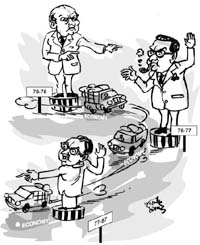 Perera, the leader of the LSSP was given the important portfolio of Finance in the 1970 government.
A component in the ideology of a corporate state was that public corporations take over, not only the strategic economic sectors but also the dominant commercial ones in the private sector, in order to allocate - through a rational plan - surpluses for further national development. In a corporate state the Minister dominated the market to enable surpluses to be generated - without exploiting the consumer-public corporations needed to be made to function economically, efficiently and effectively. These 3Es deal with output control. Public departments, on the other hand, were managed by input control. They were reviewed as to whether their expenditures were within the ambit of appropriation, whether they were incurred with integrity, and whether they were within the sum provided.
The control agencies in the Treasury responsible for public departments were the budget division and the finance division. The budget division allocated the funds and the finance division looked at whether expenditures were incurred within the rules. The personnel who were responsible for undertaking these responsibilities needed administrative skills not managerial ones. Goods governance for public administration was not to make waves or put the hand in the till. Maintenance of the system was important for public administration but performance was not emphasized.
In this culture of input control, Dr. N.M Perera correctly felt that public corporations should strike out on new paths. New mechanisms of control based on output were required.These output control measures were to be exercised by a new cadre of managers specialised in this field.
Accordingly, Dr. N.M Perera created the Corporations Division in the Treasury in 1971. Its legislative mandate was given by Finance Act No 38 of 1971. The personnel required to implement this Act which was the good governance agenda for a corporate state - required managerial skills with a strong finance background.
Accordingly, the first Director of Corporations Division was P.M.W Wijesuriya, a very senior Chartered Accountant. He built an enviable team of professional accountants to help him with the task of building the division. On his promotion as Auditor-General, he was succeeded by his deputy, M.K.S.K. Siriwardhana who was also a very senior Chartered Accountant.
On his promotion as sen ior Deputy Auditor General he was succeeded by his deputy, - the late M.J. Silva - another senior Chartered Accountant. Dr. N.M. Perera was a demanding and brilliant finance minister. He was extremely happy about the performance of the corporations division in its drive towards establishing an efficient corporate state. So was Felix Dias Bandaranaike who succeeded to the finance portfolio.
The 1977 election brought the UNP to power. It had a different concept of the state. The state was liberal with the corporations sector playing a diminishing role in commercial activities. The private sector was clearly demarcated as the engine of growth not the corporations sector.
The market was more important than the minister. If corporations needed to be retained then they should be able to compete with the private sector on a level playing field. The corporations inherited by the UNP were monopolies functioning with administered prices. To make them congruent with UNP policy they had to be re-oriented.
Such a re-orientation was to be initiated by the finance ministry under the new UNP Minister Mr. Ronnie de Mel. He decided that the stimulus was to be from two sources, firstly from a revamped corporations division and secondly from Parliament whose active support was to be canvassed to achieve this aim. It would have been the easy option to abolish the corporation division, distribute its functions hither and thither. But Ronnie de Mel, being a knowledgeable historian and seasoned Civil Service administrator, before he graduated into politics, realised that such a policy was short-sighted and will only lead to dither. He felt, and correctly, that the challenge was to re-orient the corporations division thus retaining its excellent personnel but yet equipping it for the new tasks. It was a question of elevating the existing corporations division to function at a higher level.
As a management theorist, Ronnie de Mel knew that there were two stages in such a re-orientation, the first was the charismatic stage where a new vision, a new mission and new systems needed to be developed. In this first stage the newly reoriented division would cultivate trustworthiness among the corporations, which it served, so that they could have satisfaction that they had a friend in the forbidding Treasury.
The reoriented division had to shift from the input control methods of control and command to relationships of partnership. The second stage was routinisation, where all these innovations were to become entrenched to enable the formation of a new culture.
The two stages required directors with quite different set of skills. The first stage required leadership skills and the second stage management skills with a mastery of higher level finance and accounting.
But before implementation, Mr de Mel sought the assistance of C. Balasingham to study issues and make recommendations. Mr. Balasigham was an outstanding civil servant of the 1960's and his period, as DST in the treasury of the 1960's, was legendary. He was now in retirement but was yanked out for this study. There could not have been a better choice. Mr. Balasingham made an extensive study, particularly of the workings of the Indian Bureau of Public Enterprises (BPE) and offered a comprehensive report. One significant component was the addition of Advance Accounts to the portfolio of the future organisation. Advance Accounts are commercial activities of government carried out by government departments. Some of the largest organisations in Sri Lanka, whether in the public or private sectors, were advance accounts one example being the Food Department. They too needed to be made managerial.
Mr. Balasingham recommended on the structure and processes of the new organisation, which he called the Public Enterprises Division (now department). The PED was to be built round the core of the earlier Corporations Division., but with the addition of Advance Accounts. The Balsingham report was extensively discussed at the Treasury and accepted.
Mr. de Mel then had to choose the first head of this division. The first stage needed distinctive capabilities in institution building. The selection was the serving director of budget. This director budget was a civil servant and had converted, in 1974, an hoary. division of the treasury called supply and cadre into the budget division with the simultaneous introduction of the planning, programming and budgeting system (PPBS). The PPBS transformed a line budget into a program budget which applied to all ministries and departments at the same time. It was an enormous system change, which if not handled properly, would have led to a collapse of the finance system of Sri Lanka. The transformation was carried out without a hitch. The budget division was restructured on the lines of the US Organisation and Management Bureau (OMB).
A Select Committee of Parliament was appointed to consider and report on the Standing Orders and the setting up of a new committee of Parliament, as the corporation sector had expanded so much that it was felt that a completely separate body, similar to the PAC should perform these functions for public corporations.
The recommendations of the Minster of Finance specifically stated that PED will provide the skills to the new committee. Subsequently Parliament amended the Standing Orders to set up a new Committee on Public Enterprises, as recommended by the Cabinet of Ministers and approved by the Select Committee. Consequently Parliamentary review of public corporations was shifted from the PAC (now COPA) to this new Committee of Public Enterprises (COPE). But there was a significant change in COPE list of responsibilities.
Earlier the PAC was charged only with reviewing accounts that is of past activities as presented by the Auditor General. COPE in addition to this responsibility was to monitor (that is review the present) and check on corporate plans (that is analyse the future). In both these activities COPE was to be assisted by PED, a distinct structural change in governance. By this measure the legislature and the executive were to work in closer collaboration. The PED was able to undertake the activities because it was the focal point for all matters pertaining to public corporations.
Therefore it knew everything about each individual corporation, its attempt being to know more about it than their managements. In this it was successful as the enthusiastic support given by COPE to its recommendations testifies. If bits and pieces of its responsibility had been distributed to other agencies in the Treasury, the impact of PED initiatives would have been minimal and COPE would have become another COPA for public corporations concentrating only on the past, as revealed by the accounts presented three or four years later.
Mr. de Mel also arranged a 7 week tour for COPE where it visited the United States, Costa Rica, Britain, France, Yugoslavia and India and the institutions of the World Bank, International Monetary Fund, UNDP and the International Centre for Public Enterprises.
Following on this study it made its first report called "Parliament and Public Corporations" in 1980. The COPE spelt out its credo, what it expects to do, and how it expects Public corporations to be reviewed. In this report it emphasised that the processing required for the analysis of performance be undertaken by the PED. The COPE said that "it will require it (PED) specialised skills if it is to radiate modernising influences into public corporations". From all accounts the PED has fulfilled these expectation of COPE from 1980 to the present day.
In addition to the Balasingham and first COPE report, the new director benefited from the recommendation of an international team of experts on how this focal point should be structured and function. The team was headed by Praxy Fernandes, the Secretary, Ministry of Finance, Government of India and former head of BPE and two British academics specialised in public enterprises.
This report was reviewed extensively by heads of corporations and approved by the Cabinet Secretary G.V.P Samarasinghe as Chairman of the Committee of Secretaries. Once the PED was created an extensive programme of training was undertaken which included the politicians forming the COPE. They were marooned in Hunas Hotel for a week where they benefited from an intense program of management training.
By end 1983 the first di rector felt that the charismatic stage was over and the routinisation stage has to take over. He voluntarily withdrew from the post but was asked to nominate the successor. He accepted an international assignment in which he was instrumental in setting up similar focal points in Tanzania, Jamaica and Seychelles.
He scanned the SLAS list but found that there was no one with the required skills to fill the post. He nominated his senior deputy, a senior chartered accountant who has gained post graduate qualifications from the ISS Netherlands on public sector management and a masters from Harvard in management. The nomination was accepted and she has been holding the post from 1984 up to today.
Under her direction the PED has not only satisfied the COPE and public service expectations but the Institute of Chartered Accountants has nominated the PED for training of its chartered students. The only other agency recognised in the public service for this purpose is the Auditor General's department.
This testifies to the excellence of staff working in the PED, which staff is now threatened with dispersal. With PED abolition the staff is entitled for retirement with abolition of office terms. At a time when a brain drain is affecting the public service, a policy of sponsoring the draining of brains in hardly a policy of good governance. It should be mentioned that PED staff had undertaken short term international assignments in Seychelles, Tanzania, Nigeria, Botswana and South Africa.
Public Corporations are now facing challenges both at vertical and horizontal levels. The vertical level globalisation and liberalisation has compelled them to take a fresh look at their vision and mission and develop appropriate structures and systems. At the horizontal level they have to shift from a public department to a corporation to company and to privatization.
All these changes have to be thought through and choreographed by a focal point on public corporations. Public Corporation numbers are also in the increase. Even today parliament's order page has a proposal to create a corporation called the Aqua- Culture Development Authority.
Distributing bits and pieces of PED to other agencies is not the answer. If other agencies are dealing with aspects of public corporations the rational approach would be to transfer them to PED, though this is not recommended since there must be some reason for such a practice.
The PED was created after considerable study, the seminal document being the Balasingham report. It also benefited from the Praxy Fernandes report which was published and extensively discussed.
It is claimed that the abolition of the PED was based on a management report the composition of which is not known nor its contents.
Vasudeva Nanayakkara, M.P., a concerned member of COPE, has asked that a copy be tabled in parliament.
This is not a confidential document and when it is presented the reasoning would become evident. But the proposed manner by which the proposal is to be implemented does not offer inspiring moments.
The Corporations Division was created to implement Finance Act No 38 of 1971. This is yet in operation. But no agency has been given this load bearing responsibility under the new dispensation.
Also deficiencies of management principle and management practice are legion. The present proposal to abolish the PED and the manner proposed for distribution of its functions will become a case study of how management change should not be undertaken. Some management familiarity by its authors would not have come amiss.
However, an institution that has existed since 1970, developed so carefully by excellent finance ministers like Dr N.M Perera and Ronnie de Mel and which has performed its tasks without criticism needs better justification for abolition than a secretive report. It is the tragedy in Sri Lanka that some of its best institutions have been abolished because political leadership has been misled by bureaucratic scheming.
An excellent example is the abolition of the Ceylon Civil Service a decision which everyone now bemoans including those who abolished it.
A more recent example is that of SLIDA, details being found in a case study called "Bureau pathology at the SLIDA" published by Konark in the book "The Third Wave: Governance and public Administration in Sri Lanka",
The destructive hurricane from the SLIDA has now come to the Finance Ministry. It takes giants to build but only pygmies to demolish. It is best if the decision to abolish the PED were kept in abeyance pending a thorough review.
In this review the views of COPE would be important. Similar to C. Balasingam recommending on the PED an outstanding public servant should review all aspects of the proposed abolition. The name of Gaya Kumaranatunge, a former DST, a Director of the ADB and currently in the private sector springs readily to mind.